
We want our information to be accessible to everyone. Please let us know if you'd like our information in a different format than we have provided on our website. We'd be happy to work with you to meet your needs. You can contact us through email (info@rallyassets.com) or the telephone (416-861-1717) to make your request.
Financing Conservation
How conservation financing could be used to protect Canada’s ecosystems
Conservation, as a field, has been chronically underfunded and investments in conservation to date have been disproportionately funded by governments and a relatively small number of philanthropic foundations.
This is problematic when the extent of international commitments made by governments around the world, including Canada, to conserve various landscapes is taken into account. Because with these types of commitments comes an enormous requirement for capital, the burden of which should not and cannot rest solely with governments and a small number of foundation actors. Nature provides a wide array of ecological goods and services to society writ large, underscoring the benefit and the opportunity for many types of investors to participate in financing the conservation of Canada’s abundant natural capital.
The Nature Conservancy of Canada and Rally Assets believe that the time is right to develop a much wider array of innovative financial approaches to conservation in order to attract other sources of capital, much of this from the private sector. Many such approaches are being used around the world that can be applied to the Canadian context. Conservation financing in Canada is a large opportunity waiting to be seized.
We hope this report helps you to understand the Canadian conservation finance landscape in the context of global best practices, the opportunity that exists to attract the needed non-traditional sources of capital into the conservation field and the need to act quickly and decisively on that opportunity.
Successful model
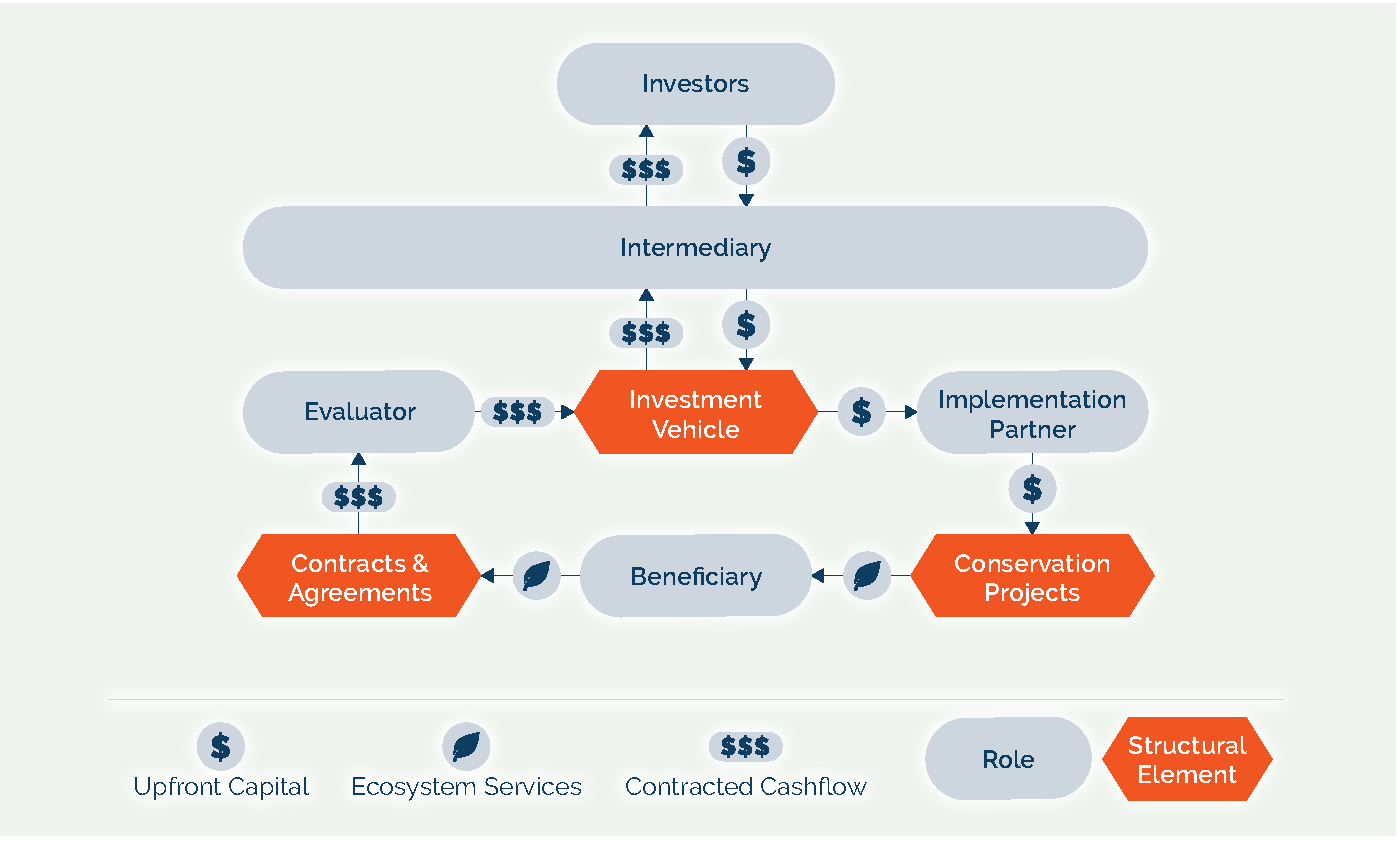
The report offers many real-life examples of the financing model in action. In general, as the graphic below shows, the model can be described in the following way:
- Investors provide upfront capital to an intermediary that structures and manages an investment vehicle. Project outcomes are established during the structuring process
- This investment vehicle provides funding for conservation projects, which are executed or overseen by an implementation partner
- Those conservation projects create value for beneficiaries, who share some of that value with the investment vehicle through contracted cashflows
- Generally, a third-party evaluator verifies the achievement of project outcomes and/or the valuation of the associated benefits to permit the funds to flow back to the intermediary
- The intermediary coordinates cashflows back to investors
To download our conservation financing report, please provide your name and email address.